What We Deserve

A year ago, my weekdays followed the fairly same routine.

Get up, sometimes work out, but most often I wouldn’t have the energy. Shower, breakfast, and then on the train for 45 minutes. At the office, I would cautiously check my email to see what fires needed to be put out, and then I would either hop on conference calls or start creating content. Lunch was always left overs or a salad from home, and the rest of the day would be set to survival mode. 4:30 p.m. came and then I was free and trying to make the next few hours last as long as I could before I would have to get up and do it all again.

I was not happy in previous career, and so I decided to make a big change in going back to school. At first, it was exhilarating and exciting, but a year later, the consequences of such a big change have been plaguing me.

As a graduate student, there is much more on my plate. In my career, I juggled projects but I was quite intentional about keeping work in the designated hours. Now, I am using every bit of the day to minimize my to-do list. With school work, two jobs, marathon training, and maintaining a life, it’s hard to fit everything in. This week, I made an hour-by-hour schedule in hopes of feeling somewhat in control of my schedule.

Also, going to school in my mid-30s has put me in a different set of circumstances than many of my friends, who are buying houses, having kids, and climbing the ranks of their respected careers. I am working a part-time retail job (which I enjoy) and living paycheck-to-paycheck.

Being a full-time student is hard, and there are times when I think I must suffer through it. I should be doing homework at 9 p.m. on a Saturday night. Or, waking up at 4:30 a.m. to get in a run is just part of the deal. By stepping outside of the normal routine for a woman my age, I was agreeing to be miserable with an unstable finances and uncontrollable schedule. That’s what I get for doing something out of conventional expectations.

Today was my day off, and so I wanted to take sometime to recuperate before another busy weekend. I took a two-hour deep nap, watched some trashy TV, and splurged on a bottle of $6.99 wine. When I say my day off, that’s relative. I still worked my school job (which I can do from home), took a final exam that lasted for two hours, and completed a fairly hard workout. Even so, I felt guilty about the nap and didn’t think I really deserved the wine. I argued that I was so lucky to have Tuesdays like this, that most people are slaving away at jobs, so who am I to enjoy a long nap in the middle of the day?

It’s often easy to think we don’t deserve things, or to be any kind of pleasure at the end of accomplishments. I don’t really need to take that trip to visit my college friend. Or, if only I can lose 10 pounds, I will let myself get that dress that I really want. We often restrict ourselves so much that when we do indulge we overdo it, whether it be food, alcohol, or shopping. We think that if we aren’t working hard, we don’t deserve to relax. We must sweat. We must shed tears. We must endure hardships, and then only then, can we have a reward.

This often happens in running. In May, I ran my first half marathon in eight years, and I had a big goal to break 2 hours (more on this later). However, I went out fast and was eight minutes slower than I had hoped. What I don’t tell people when I share this story is that I also PR’ed by 17 whole minutes. That is incredibly impressive, and yet I wouldn’t let myself bask in that glory because my primary goal wasn’t met.

Often, runners only focus on times, and we forget to look at other accomplishments we may have that don’t involve the clock. Maybe we didn’t get a PR that day, but we were better with nutrition and avoided bonking. Or, we encouraged a fellow runner out on the course and helped her overcome a specifically dark time. We don’t allow ourselves to enjoy successful or indulgent moments outside of our expected goals, because we don’t think we deserve them.

This morning, I dominated a hard workout, and then I spent two hours giving my best on a final exam. Not only did I earn that nap and glass of wine, I deserved it. Graduate school, and the life that comes with it, is hard enough, but I have to make time to enjoy it and take care of it. It doesn’t all need to be a slog fest. Changing my life allows me to spend my Tuesdays in a different way, and that won’t always be the case when I graduate and am building up my career, so I better enjoy it.

Just because we made a choice to live differently, to take a more unique path, doesn’t mean we have to suffer. We deserve to enjoy pleasures and to relax, because if we don’t, we’ll lose sight of what we are trying to accomplish, and we’ll lose ourselves.
I Love/Hate Strava

A few months ago, I went on a social media cleanse. After a particularly tough day, I deactivated my Facebook, Twitter, and Instagram accounts. I needed a break from everyone’s highlight reels and comparing my worsts to their bests. I kept Snapchat for cute videos of my nieces and nephews, LinkedIn account because it’s not as a threat to my mental health like the others, and Strava to track my workouts.

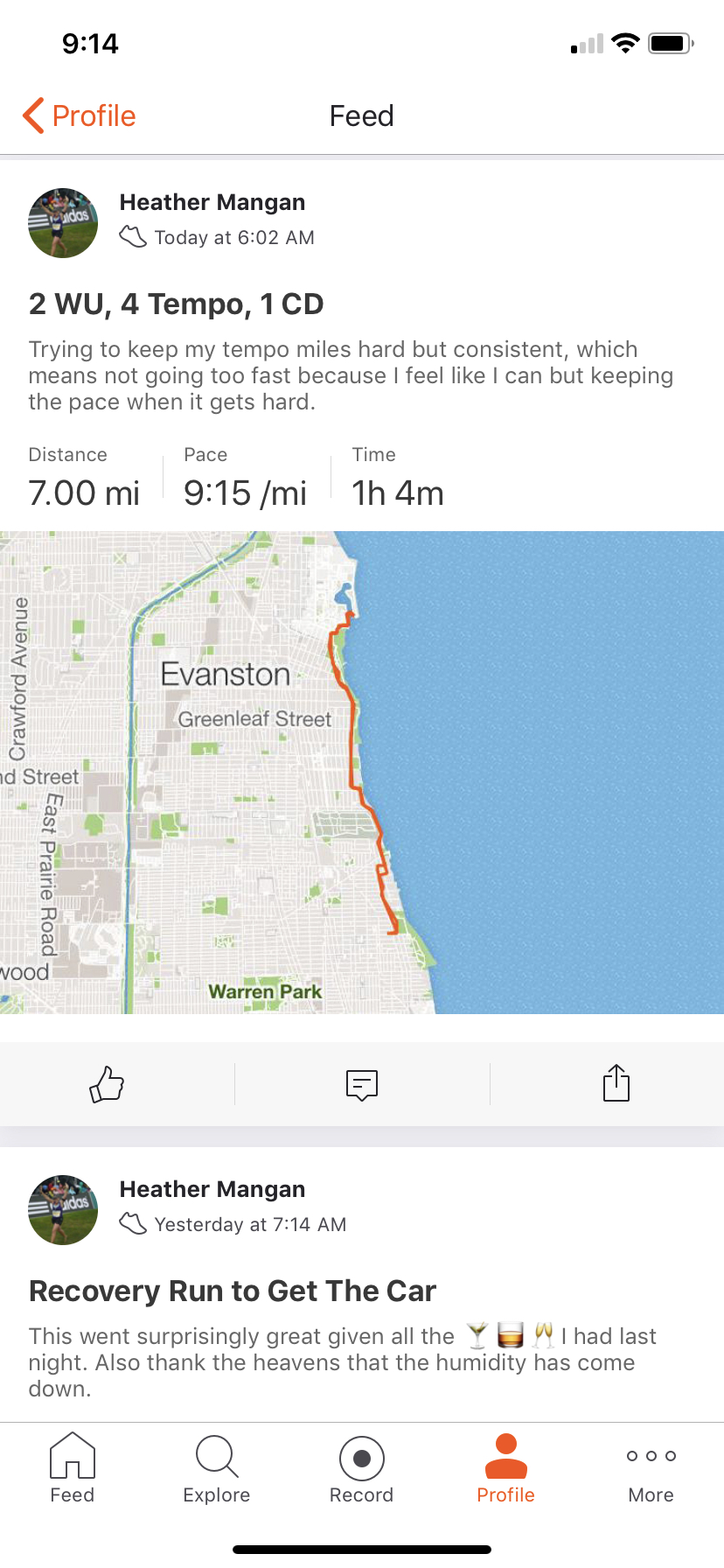
I created a Strava profile a few years ago, but it wasn’t until earlier this year that I became more of an active user. If you have never used Strava before, it’s like Instagram for your workouts. You can use the app to record a workout or sync your GPS watch and it captures numbers that describe your run. It’s incredibly satisfying, at the end of a run, to see that freshly published workout with all the data of pace and heart rate as well as the map of your route. Then, you get to sit back and watch the kudos, or likes, come in.

Not many of my friends use the social media platform, so a few months ago, I tried to find as many runners in the Chicago area as I could. I also found people’s whose blogs I’ve read for years and some of my favorite celebrity runners. I didn’t know most of the people I was following, but I loved watching their runs and learning about what kind of workouts they were doing. Strava also keeps tracks of how many miles you do each week, month, and year, and it’s a great confident-booster to see that number climb each day.

One of my favorite parts of Strava is seeing where people are running. In Chicago, the most common place to run is the Lake Shore Path, but I live a few miles from the trail, so I usually only go there when I am doing longer runs. For my daily runs, I do the same out and back along a pretty busy road, and it can get tedious. But, through Strava, I’ve been able to find alternative running paths, including trails and parks that I would have never thought to check out. My go-to place for tempo runs and hills is a park I discovered through someone I follow on Strava.

Through my training group and working part-time at a running store, I’ve started to meet many of the people I follow on Strava in real life in addition to making new friends and then finding them on Strava. The app even knows if you are running with someone and will automatically sync your posts, which is kind of fun when you are in a group run and don’t necessarily know everyone yet. I feel like I have a little community of fellow runners cheering me on after every run.

However, Strava is still a social media, and it comes with some of the same nasty side effects as Instagram and Facebook.

While it was fun to find more of my real friends on Strava, the beauty of following and being followed by mostly strangers is that I didn’t care what they thought of my runs. However, I am now more conscious of what my pace will record on the app and who will see it. Maybe it’s a friend who is a lot faster than me and he’ll think I am quite slow and “not a real runner.” Or, a friend I’ve been running with who is pushing me and she sees that my pace is slower than what we’ve been doing together. Will she be disappointed?

On some runs, when I am not in a good place, I will think mostly about how the numbers will look on the app and completely disregard how I am feeling. I put the post and how it will be perceived ahead of my fitness and health.

Also, while I enjoy seeing distances and paces, Strava was practically built for runners to compare themselves to others. We runners already do that, but it is more accentuated on the app. I am constantly scrolling through friends’ activity logs to see how they did in a specific race, what their typical heart rate is, and how many miles they’ve done this year. And, that’s when I sink into the comparison despair.

I am not fast enough.

My heart rate is too high.

I am not going far enough.

The other day, I had just finished a long run and was feeling fairly good about it. I logged my workout to Strava, and then came back to the app a few hours later to see my kudos and what other people had done that day. One post was from a woman who I have never met but are connected through mutual acquaintances. We are running the same marathon in October and our paces are fairly similar. Her long run that day was several miles more than mine, as was her weekly mileage. I started to panic that I wasn’t doing enough and that my training was maybe too easy. 

This self-doubt lingered for a few hours, and this is why I have a troubled relationship with Strava. If it wasn’t for the app, I wouldn’t know anything about her training, nor would I have any reason to compare it to my own. I have lots of friends who are faster and run further than me, and their harder workouts don’t seem to bother me, but when someone is right at my level I automatically stack her against myself. It’s practically habit.

Training for a marathon by judging yourself next to someone else’s paces and mileage is a really crappy way to train for a marathon. Someone else’s running is not my running, and if I continue to fixate on where I am compared to others, I will burnout or, worse, end up injured. Running will lose its joy, and I will be chasing numbers, which again is a really terrible way to train.

Sometimes we have to remind ourselves that numbers are just half the story. The other day, I had a great run in which my pace was dropping each mile, but two different times I forgot to pause my watch when I stopped for water and at a red light. My overall pace was slower because of the elapsed time, however it wasn’t reflective of how hard I worked. We can go ahead and publish our run data to Strava or Instagram, but we are the only ones that know what that felt like. And that goes with others. Just because someone ran seven miles at 6:30 pace doesn’t mean it was a great run.

Because I do really like Strava, I am not reading to give up on it. Yes, scrolling through on a Sunday morning can cause me to question my own training and abilities, but that is on me. I can still be on Strava but put up boundaries to not let it define me as a runner. That will take some self-esteem work on my part and a remember that numbers are just numbers and progress can also be felt. In the end, what matters more than the data posted is that I keep showing up day after day.  

I want to hear from you! Do you use Strava? Do you like it? Also, let’s be friends!