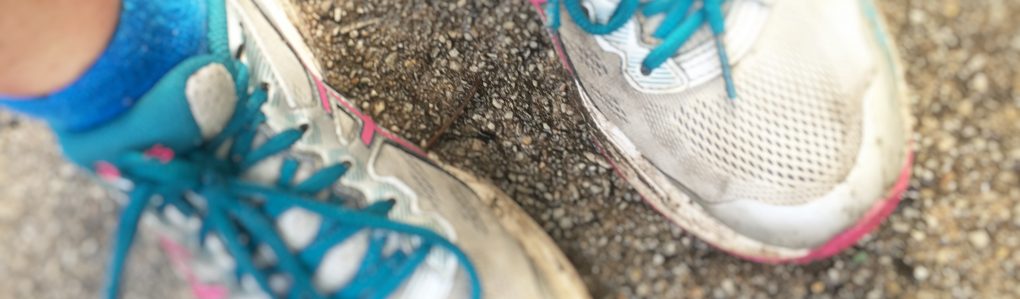

On Thursdays, I run with a local training team, and today’s workout was centered around a timed mile. As the coaches explained it, this mile would help give us a good idea of what pace we should be doing our other runs, and more importantly, act as a measurement of our progress. In the fall, we’ll do another, and if all goes correctly, we’ll be astonished at how faster we’ve gotten.
This mile test scared me. My strength as a runner (and also when I was a competitive swimmer) is endurance. I am not quick, but I can keep strong paces for several miles. This spring, when training for a half marathon, some of my speedier miles were at the tale end of 10, 13, and 15-mile runs. One fast mile? I wasn’t sure I could work up enough acceleration to produce a time I was proud of. Which was another source of anxiety. I feared that my mile time would show that I should be running my long runs at a slower pace and that I’ve been tampering with my ability to run a good race by going to hard in my workouts. Lastly, I don’t have much experience with a timed mile. The last one I did was when I was a junior in high school during track.
Let me talk about track for a second. I hated it, but I knew it was the only way to keep up my fitness for cross country season. For the long distance girls team, I was the slowest runner, which meant that my coach, Mr. Gusso, paid me no attention. I cried after every race because I wanted to be better than I was, but my times got slower. (“Girls times always get slower,” Mr. Gusso told me. Cool guy.) I specifically remember running that mile race as a junior, because I was planning not to go out for the sport my senior and I was thrilled that it was my last one. Never again, I thought, until I decided to be all sporty and join a local running team and they were like, “hey this will be fun” and I wanted to give up running for forever so I didn’t have to do this dumb thing.
Can you tell that I was in my head just a bit?
For at least 24 hours before the workout, I thought about skipping the group and doing it on my own. By myself, I could do it on the Lakefront Path or in loops around a nearby park. Without anyone else nearby, I wouldn’t be as ashamed at the time on the clock.
This happens to us a lot when we are scared, of both little and big things. We try to bargain our way out of doing something hard because we are afraid of failing. Instead of skipping the run, I started to question why I had the urge to do so. So what if I didn’t run as well as I wanted? How would that change my attitude towards running or myself as a runner? What importance does it really have?
Hardly any.
The truth is, it didn’t matter how fast I ran that thing—above or below an arbitrary goal—because I would go home that night, eat a cookie, and go to sleep. Then the next morning I would continue on with my training.
When I questioned my fear, it lost its power. Sure, I was still nervous when I toed the line, but I knew that it would be over in less time than it takes to wait for the bus.
A big inspiration was the other runners. They divided us into groups, and because I was in the second group, I watched from the inner field as the others completed the trial. Some of these were veteran runners, but many new. They were of all ages and sizes, but they were doing it. For them, the time was irrelevant. Rather, it was just accomplishing the goal. If they could look at the mile and devour it, so could I.
And, I did. The first loop hurt my lungs, but my pace quickened in the second loop. I settled into the third, and by the fourth, I couldn’t believe it was almost over. I recorded a 7:32 pace, which is good for me and doesn’t need any comparison.

Running reminds us that we can do hard things. Sometimes that’s run a mile, sometimes that’s run 26 miles. While challenges in running seem minuscular compared to those in life, like divorce or the death of a loved one, our spirit and strength in overcoming them are built of the same materials. In running, we understand our courage, and if we can muster it up to run a fast mile that makes us nearly vomit, imagine what we can do when life breaks our heart.
That’s why I showed up to the run today. Overcoming this little fear and giving that mile my all is good practice for other challenges, and when they come, me and my 7:32-mile will be ready.



 The Running Therapist